

If your tax home is in a foreign country and you pass either the bona fide residence test or the physical presence test, the foreign earned income exclusion (FEIE) lets you exclude up to $132,900 of foreign earned income for the 2026 tax year, and up to $130,000 for 2025. You claim it on Form 2555, attached to your Form 1040, and you only get it if you file the return and report the income. The exclusion also reduces income tax only, so it leaves self-employment tax untouched.
Three things have to be true at the same time:
- You have foreign earned income.
- Your tax home is in a foreign country.
- You are a US citizen or resident alien who passes one of the two residence tests.
What is the Foreign Earned Income Exclusion?
The exclusion takes a block of your foreign earned income out of your taxable income, and Form 2555 is the election: it is how you tell the IRS you are taking the exclusion and how you work out the amount. As a US citizen or resident alien living abroad you are taxed on your worldwide income, so the exclusion is relief from that tax, not an exemption from the filing system itself.
The exclusion lowers your taxable income, not your tax rate
The exclusion removes an amount of income from the figure you are taxed on, but it does not move you down the rate table. Tax on whatever income is left is figured using the rates that would have applied if you had not claimed the exclusion, through the Foreign Earned Income Tax Worksheet in the Form 1040 instructions. So if you earn more than the maximum, the balance is not taxed as though it were your only income.
You still have to file a US return and report the income
Taking the exclusion does not take you out of the US tax system. According to the IRS, US citizens and resident aliens abroad are taxed on worldwide income, and the exclusion applies only if you file a return that reports the income. When you test whether your income is high enough to require a return, you count your foreign earned income before the exclusion, so a salary that is fully excluded can still oblige you to file. A separate guide explains why Americans abroad still file a US return.
Form 2555 is the claim form
The exclusion is voluntary, and you choose it by completing the appropriate parts of Form 2555 and attaching the form to your return. Nothing happens automatically: if the form is not there, the exclusion is not claimed. The amount you work out on Form 2555 is then carried to Schedule 1 (Form 1040) as a negative amount with the notation “Form 2555”.
How much Foreign Earned Income can you exclude under the FEIE?
For tax year 2026 the maximum is $132,900 per qualifying person, and for tax year 2025 it is $130,000. You exclude the lesser of that maximum or your foreign earned income, and the maximum is cut down if you qualified for only part of the year.
| Tax year | Maximum exclusion per qualifying person | Source |
|---|---|---|
| 2026 | $132,900 | Revenue Procedure 2025-32 |
| 2025 | $130,000 | Revenue Procedure 2024-40 |
The maximum is a ceiling, not an entitlement
You exclude the lesser of the maximum for the year or the foreign earned income you actually have, so the figure is a ceiling rather than an entitlement. If you earned $60,000 abroad in 2026, your exclusion is $60,000, not $132,900. The figures above come from the annual revenue procedure that indexes the limit, under the part of section 911 that sets the maximum.
Married couples: each spouse has a separate exclusion
The maximum applies per qualifying person, not per return. If both of you work abroad and each of you meets the tax home requirement and one of the two residence tests, each of you can choose the exclusion on your own foreign earned income. Together that comes to as much as $265,800 for the 2026 tax year, or $260,000 for 2025.
One spouse qualifying does not carry the other, and neither of you can use the unused part of the other’s maximum. Community property laws do not change the split either: each exclusion is figured separately on that spouse’s own Form 2555.
The limit is prorated for a part-year qualifying period
Where your qualifying period covers only part of the tax year, you scale the maximum down:
- Take the maximum exclusion for that tax year.
- Multiply it by the number of qualifying days falling in that year.
- Divide by 365, or by 366 in a leap year.
Qualifying days are the days inside the period during which your tax home was in a foreign country and you were either a bona fide resident or met the physical presence test.
A calendar-year taxpayer establishes a tax home and bona fide residence in a foreign country on August 14, 2025 and keeps both until January 31, 2027. Applying the three steps to the 2025 tax year:
- Take the 2025 maximum exclusion, which is $130,000.
- Count the qualifying days falling in 2025, from August 14 to December 31, which come to 140.
- Multiply 140/365 by $130,000 to give a 2025 maximum of $49,863.
| Situation | Qualifying days in the year | Maximum for that year |
|---|---|---|
| Qualifying all year, 2026 | 365 | $132,900 |
| Marcus, arriving March 1, 2026 | 306 | $111,418 |
| IRS example, arriving August 14, 2025 | 140 | $49,863 |
Income above the limit is still taxed
Anything over the maximum stays in your taxable income and is taxed in full. Because the excluded amount still sets the rate band, that remaining income is taxed at the rates that would have applied if the excluded income were still in your taxable income, not from the bottom of the rate table.
Who qualifies for the Foreign Earned Income Exclusion?
Three conditions have to be met together: you must have foreign earned income, your tax home must be in a foreign country, and you must be a US citizen or a qualifying resident alien who passes either the bona fide residence test or the physical presence test. Fail any one of the three and the exclusion is not available, however long you have been abroad.
Citizenship and residence status: the three qualifying classes
The IRS sets out three qualifying classes:
- A US citizen who is a bona fide resident of a foreign country or countries for an uninterrupted period that includes an entire tax year.
- A US resident alien who is a citizen or national of a country with which the United States has an income tax treaty in effect, and who is a bona fide resident of a foreign country or countries for an uninterrupted period that includes an entire tax year.
- A US citizen or US resident alien who is physically present in a foreign country or countries for at least 330 full days during any period of 12 consecutive months.
The treaty-country condition appears in the second class only. It attaches to the bona fide residence route, not to the physical presence route, so a green card holder from a country with no US income tax treaty can still qualify by counting 330 full days.
Your tax home must be in a foreign country
Your tax home is your regular or principal place of business, employment or post of duty, regardless of where you keep your family residence. If the nature of your work means you have no regular place of business, your tax home is the place where you regularly live. Work in a foreign country that is expected to last for an indefinite period, rather than a temporary one, points toward a foreign tax home.

The foreign tax home also has to hold throughout the period you are relying on, whether that is the period of bona fide residence or the period of physical presence. A gap in the foreign tax home is a gap in your qualifying period.
A US abode can disqualify you
You do not have a foreign tax home for any period in which your abode remains in the United States. Your abode is where you maintain your family, economic and personal ties, so it is about where your life is anchored rather than where you sleep on a given night. Keeping a dwelling in the United States, or being there temporarily, does not by itself put your abode there, but both facts can point that way.
The IRS gives the example of a worker on an offshore oil rig in a foreign country’s territorial waters, working a 28-days-on, 28-days-off rotation. That worker returns to the family home in the United States during each break, so the abode stays in the United States and the tax home test fails. The exception is service in a Presidentially designated combat zone in support of the US Armed Forces, where a US abode does not prevent a foreign tax home.
The FEIE Bona Fide Residence Test: a full tax year living abroad
You meet this test if you are a bona fide resident of a foreign country or countries for an uninterrupted period that includes an entire tax year. For a calendar-year taxpayer that means January 1 to December 31, with no break in the residence itself.
The test is open to US citizens, and to resident aliens who are a citizen or national of a country with which the United States has an income tax treaty in effect. Your tax home has to be in a foreign country throughout the period of residence.
The uninterrupted period must include an entire tax year
The period of residence has to be continuous and it has to swallow a whole tax year. Two things follow from that:
- Trips back to the United States do not automatically end it, because what breaks the test is an interruption in the residence itself rather than a visit.
- A residence that begins in June cannot satisfy the test in that first year, since no full tax year sits inside it yet.
That does not make the first and last years of a stay dead years. Once the uninterrupted period is established, the qualifying days can run before and after the full tax year it contains, so the year you arrive and the year you leave are usually part-year claims rather than failures.
The nonresidence statement question on Form 2555
Part II of Form 2555 asks two linked questions at lines 13a and 13b:
- Whether you submitted a statement to the authorities of the country you live in saying you are not a resident there.
- Whether you are required to pay income tax to that country.
If you answer that you did submit such a statement and that you are not required to pay income tax there, you do not qualify as a bona fide resident, and you leave the rest of Part II blank.
The instructions go further: a statement of nonresidence also disqualifies you while the foreign authorities have made no final decision on your status. A declaration you give another country to stay outside its income tax can therefore cost you this test, so check what you have told that country before relying on bona fide residence.
The FEIE Physical Presence Test: 330 full days in any 12 consecutive months
You need at least 330 full days in a foreign country or countries during any period of 12 consecutive months. The 12-month period does not have to line up with the tax year, and you are the one who picks it.

Unlike the bona fide residence test, this one does not look at the kind of residence you established, whether you meant to come back, or the purpose of the stay. Your tax home must still be in a foreign country throughout the period of physical presence, and for this purpose that period is the 330 full days. Resident aliens can use this test whether or not their country has a US income tax treaty.
Counting full days in a foreign country
A full day is a 24-hour period, starting at midnight, spent in a foreign country. The 330 days do not have to be consecutive, but the definition rules out more than people expect:
- The day you fly out of the United States is not a full day.
- The day you fly back is not a full day either.
- Time in or over international waters or airspace is not time in a foreign country, although a trip between two foreign countries that takes less than 24 hours costs you no full day.
- Time spent in Cuba in violation of US travel restrictions cannot be counted toward either this test or the bona fide residence test, and income earned there is not foreign earned income.
A 12-month period with 35 days outside a foreign country leaves exactly 330, so two travel days wrongly counted as foreign days bring the real total to 328 and the test fails.
Choosing the 12-month period with the largest exclusion
Because the 12 months can be any 12 consecutive months, there is usually more than one window that contains 330 full days. The window you pick decides which days fall inside your qualifying period, and your qualifying days in a given tax year decide how much of the maximum you can use.
Where you qualified for only part of a year, that choice changes the number directly. Move the start date forward or back by a few weeks and the prorated maximum for the year moves with it, so it is worth testing more than one window before you settle on one.
Bona Fide Residence or Physical Presence: which FEIE test fits your situation?
You only have to pass one of them. The bona fide residence test suits someone settled abroad for the long term, and the physical presence test suits someone whose stay is shorter, less settled, or spread across several countries.
| What it turns on | Bona fide residence test | Physical presence test |
|---|---|---|
| Who it is open to | US citizens, and resident aliens who are a citizen or national of an income tax treaty country | US citizens and US resident aliens, with no treaty-country condition |
| The time requirement | An uninterrupted period of residence that includes an entire tax year | At least 330 full days in a foreign country or countries |
| The period it is measured over | A whole tax year, so January 1 to December 31 for a calendar-year taxpayer | Any 12 consecutive months, which you choose and which need not match the tax year |
| What it looks at | The nature of the residence itself, as a question of fact | A count of full days, regardless of the kind of residence, intentions about returning, or the purpose of the stay |
| Where the tax home has to be | In a foreign country throughout the period of bona fide residence | In a foreign country throughout the 330 full days |
| The situation it usually fits | Someone settled abroad with no fixed return date | Someone on a defined assignment, moving between countries, or in their first or last year abroad |
The IRS treats the qualifying classes as alternatives, so meeting either test is enough and there is nothing to gain from meeting both. If your facts fail one test in a particular year, check the other before you assume the exclusion is gone: the year you arrive often fails the residence test and passes the presence test.
Can the FEIE time requirements be waived?
Yes, in limited cases. Where war, civil unrest or similar adverse conditions forced you to leave a foreign country, the minimum time requirements under both tests can be waived, and you claim for the days you were actually there. The relief applies where your tax home was in a foreign country and you were a bona fide resident of, or physically present in, that country when you had to leave.
The waiver is not automatic, and it carries two conditions:
- You have to show that you could reasonably have expected to meet the minimum time requirements had you not been required to leave.
- The country and your departure dates have to appear on the list the IRS publishes each year in the Internal Revenue Bulletin, which names the only countries that qualify for the previous year and the dates they qualify.
A departure from a country or period the IRS has not listed does not qualify, however difficult conditions were for you personally.
Where the waiver applies, you exclude by reference only to the days you were a bona fide resident of, or physically present in, the country. You attach a statement to your return explaining that you expected to meet the time requirement but conditions in the country prevented the normal conduct of business. You also enter “Claiming Waiver” in the top margin on page 1 of Form 2555.
What counts as Foreign Earned Income for the FEIE?
Only earned income for personal services you performed while abroad is covered: pay, salary, professional fees and self-employment earnings. Investment income, pensions, social security and US government pay are not.
| Type of income | Excludable? | Why |
|---|---|---|
| Wages, salaries and professional fees for services performed abroad | Yes | Pay for personal services in a foreign country during your qualifying period |
| Noncash pay, allowances and reimbursements | Yes | Compensation for the same services, such as an employer-provided home or car |
| Foreign earned self-employment income | Conditional | Only the earned part of business income qualifies, and self-employment tax still applies |
| Pay as a US government employee, military or civilian | No | Excluded from the definition wherever you are posted |
| Pay for services in international waters or airspace | No | Not performed in a foreign country |
| Pensions, annuities and social security benefits | No | Not earned income |
| Interest, dividends and capital gains | No | Investment income, not pay for services |
| Pay received after the end of the tax year following the year of the work | No | Received too late to qualify |
| Meals and lodging already excludable under another rule | No | Already outside your income, so not excluded twice |
Income that qualifies
Under the IRS definition, foreign earned income is pay for personal services you performed in a foreign country during the period in which you meet the tax home test and one of the residence tests. Beyond wages, salaries and professional fees, it includes noncash pay such as a home or car provided by your employer, and allowances or reimbursements.
Some payments look like pay but fall outside the definition. Amounts received from a corporation that are really a distribution of its earnings and profits, rather than reasonable compensation for your services, are not foreign earned income. If you control the company and set your own salary, the split between pay and profit extraction therefore matters.
Business profit needs one more check. Where personal services produce the income and capital is not a material income-producing factor, your entire gross income from the business is earned income. Where both capital and personal services are material factors, only a reasonable allowance for your services counts, capped at 30 percent of your share of the net profit after the deduction for the employer-equivalent portion of self-employment tax.
Income that does not qualify
Pay as a military or civilian employee of the US government or any of its agencies falls outside the definition, whichever country you are posted to. Pay for services performed in international waters or airspace is also outside it, because neither counts as a foreign country. Pensions, annuities and social security benefits are not earned income, and neither are interest, dividends or capital gains.
Income that is already excludable under another rule cannot be excluded a second time. The main example is the value of meals and lodging your employer provides on its business premises for its own convenience, where you must accept the lodging as a condition of employment. Payments that reach you after the end of the tax year following the year you did the work are also outside the definition.
Working remotely for a US employer while you live abroad
The exclusion turns on where you performed the services, not on who paid you or where the money landed. Pay for work physically done in a foreign country can be foreign earned income even though your employer is American, your contract is American and your salary goes into a US bank account.
The reverse applies just as strictly. Days you spend working inside the United States during the year are not days of foreign service, so the pay for those days is not excludable and has to be separated out from the rest.
Pay you receive in a later year
You are generally treated as earning income in the year you do the work, even if the money arrives the following year, and you apply the income to the year it was earned when working out what you can exclude for that year. There is a hard stop on this: income you receive after the end of the year following the year you did the work cannot be excluded at all. Work done in 2026 and paid in 2028 is outside the exclusion.
A bonus covering a stretch of work is split rather than dropped into one year. Divide the bonus by the number of calendar months in the period you did the work that produced it, then multiply by the number of those months falling in the year you are claiming for.
There is one exception for a cash-basis taxpayer, where salary or wages received after the end of the year of the work are treated as earned entirely in the year received. All four of these must apply:
- The period is a normal payroll period of your employer that regularly applies to you.
- It includes the last day of your tax year.
- It is no longer than 16 days.
- The payday falls at the same point relative to the payroll period as it normally does, and before the end of the next payroll period.
Self-employed taxpayers and the FEIE: income tax, self-employment tax and expenses
The FEIE reduces your income tax, not your self-employment tax. If you are self-employed and exclude your whole profit, you can still owe Social Security and Medicare tax on that same profit, and the deductions tied to the excluded income are cut back as well.
The exclusion reduces income tax, not self-employment tax
A qualifying individual can claim the exclusion on foreign earned self-employment income, and the excluded amount comes off regular income tax. It does nothing to self-employment tax. So a freelancer abroad who excludes every dollar of foreign profit can have no income tax to pay on that profit and still owe self-employment tax on all of it.
Whether a social security agreement between the United States and the country you work in removes that liability is a separate question, decided by that agreement rather than by Form 2555.
Expenses tied to excluded income cut your exclusion
You cannot take deductions against income you have excluded. The exclusion is therefore reduced by the pro rata share of the expenses definitely related to your foreign earned gross receipts, and by the same share of the deduction for one half of your self-employment tax.
The IRS illustrates the reduction with this 2025 example:
| Figure | Amount |
|---|---|
| Schedule C gross receipts | $150,000 |
| Schedule C expenses | $50,000 |
| Schedule C net income | $100,000 |
| Self-employment tax | $14,130 |
| Deduction for one half of self-employment tax | $7,065 |
| Maximum exclusion for 2025 | $130,000 |
- Divide the maximum exclusion of $130,000 by gross receipts of $150,000.
- Multiply that fraction by the expenses plus the half of self-employment tax, being $50,000 plus $7,065.
- The allocable expenses come to $49,456.
- Subtract $49,456 from $130,000 to give $80,544.
The $49,456 goes on line 44 of Form 2555, and the resulting $80,544 on line 45 is carried to Schedule 1 (Form 1040) as a negative amount with the notation “Form 2555”. The Schedule C expenses and the self-employment tax deduction are still reported in full; Form 2555 removes the disallowed share. If you are self-employed you may also be able to claim the foreign housing deduction in place of the foreign housing exclusion.
How do you claim the exclusion on Form 2555?
You complete the relevant parts of Form 2555 and attach it to your Form 1040 or 1040-SR, or to Form 1040-X if you are amending. The first-year election is normally made on a timely return, an amended timely return or a return filed within one year of the original due date, and a fourth route stays open after that in limited circumstances.
The filing sequence itself is short:
- Work out your qualifying period and your maximum for the year.
- Complete either Part II for bona fide residence or Part III for physical presence, never both, along with the income and computation parts.
- Attach Form 2555 to your Form 1040 or 1040-SR. If you file on paper, mail it to the special IRS address for returns with Form 2555 attached, not the address for your state.
- Carry the exclusion figure to Schedule 1 (Form 1040) as a negative amount with the notation “Form 2555”.
In your first year abroad you may not have met either test by the due date of your return, even with the automatic two-month extension available to taxpayers living abroad. The IRS then offers two routes: apply on Form 2350 for a special extension to a date after you expect to qualify, filed before the return’s due date, or file on time without the exclusion and amend once you qualify. Interest runs on any tax not paid by the regular due date either way.
The three standard routes for making the election
According to the IRS, the initial choice to exclude generally has to be made on one of three returns:
- A timely filed return, including any extensions.
- A return amending a timely filed return.
- A late-filed return filed within one year from the original due date of the return, determined without regard to any extensions.
Filing late does not by itself cost you the exclusion, provided the return is filed within one year of the original due date rather than the extended one.
Claiming the exclusion on a return filed more than one year late
Past those periods there is a fourth route, with a condition attached. You can still choose the exclusion if:
- You owe no federal income tax once the exclusion is taken into account; or
- You do owe federal income tax after taking it into account, but you file before the IRS discovers that you failed to choose the exclusion.
If you owe federal income tax after the exclusion and the IRS gets there first, this route closes. You then have to request a private letter ruling under Treasury Regulation section 301.9100-3, following the instructions in the first Revenue Procedure the IRS issues each year.
Once made, the choice carries forward to later years
You elect once, not annually. The choice stays in effect for the year you made it and for all later years unless you revoke it, so you complete Form 2555 each year to compute the amount without re-electing. A year with no foreign earned income does not require you to revoke the election either.
Revoking the FEIE election and the five-year rule
You can revoke the exclusion for any year by attaching a statement to that year’s return. The statement goes with the return or amended return for the first year in which you do not wish to claim the exclusion, and it has to say which choices you are revoking. The foreign earned income exclusion and the foreign housing exclusion are revoked separately, so revoking one leaves the other standing unless you say otherwise.
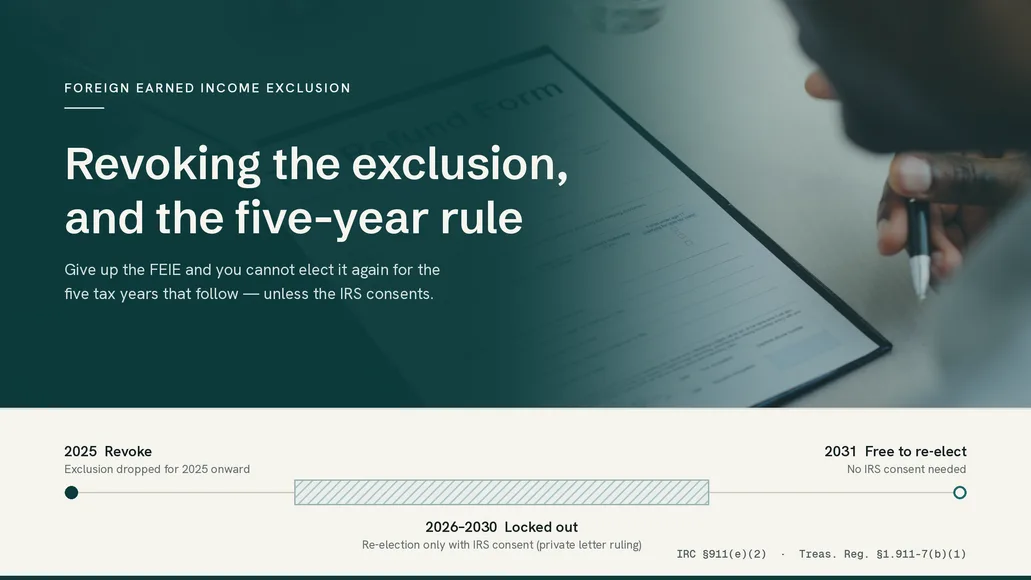
The cost comes if you change your mind. If you revoked a choice and within five tax years want to make the same choice again, you need IRS approval. You request it by asking for a ruling and mailing the request in duplicate to the Associate Chief Counsel (International). The IRS charges a fee for issuing these rulings and will weigh any relevant facts and circumstances, which may include:
- A period of residence in the United States.
- A move to another foreign country with different tax rates.
- A substantial change in the tax laws where you live or are present.
- A change of employer.
After the five tax years are up, you can choose the exclusion again without a ruling.
Limits of the FEIE: credits, housing, reporting and state tax
The FEIE is narrow: it does not touch your foreign account reporting, it closes off the foreign tax credit on the same income, it does not cover housing on its own, it costs you two credits, and your state may ignore it entirely. Each of these sits alongside the exclusion rather than inside it.
You cannot take a Foreign Tax Credit on income you excluded
Once you choose the exclusion, you cannot take a foreign tax credit or deduction for taxes on income you excluded or could have excluded. The credit is still open on foreign earned income above the amounts you excluded, so a high earner can use both in the same year on different slices of income. Claiming a credit on excluded income can be treated as revoking the election.
Choosing between the exclusion and the credit
Where your foreign earned income sits at or below the maximum, the two reliefs are alternatives rather than a pair, and taking one shuts the other off on that income. The better choice turns on the foreign tax rate you pay, the credits you lose under the exclusion, and what happens in later years.
Foreign housing costs are a separate claim
The foreign housing exclusion and the foreign housing deduction are separate claims from this one. Where you claim a housing exclusion, it is worked out first and your foreign earned income exclusion is then limited to your foreign earned income minus the housing exclusion.
| Tax year | Housing expense limitation | How it is set |
|---|---|---|
| 2026 | $39,870 | Generally 30 percent of the maximum foreign earned income exclusion |
| 2025 | $39,000 | Generally 30 percent of the maximum foreign earned income exclusion |
The limitation varies with where your foreign tax home is and with your number of qualifying days.
Credits you give up: Additional Child Tax Credit and Earned Income Credit
If you exclude foreign earned income you cannot take the additional child tax credit, and you do not qualify for the earned income credit for that year. For a family with children and a modest foreign salary, those two credits can be worth more than the tax the exclusion saves.
Your foreign account reporting does not go away
Excluding income changes what you are taxed on, not what you have to report. Your foreign bank and investment accounts still fall to be reported on their own terms, whatever your Form 2555 ends up saying. The FBAR and Form 8938 carry their own thresholds, deadlines and filing rules.
Your state may not follow the federal exclusion
The exclusion is a federal rule, and a state you remain connected to may tax the income the IRS lets you exclude. That can leave you with no federal tax on a salary and a state return that still wants it.
Common FEIE and Form 2555 mistakes
Most errors come from treating the exclusion as broader than it is, or from counting days and years the wrong way.
- Assuming you no longer have to file a US return: the exclusion applies only on a filed return that reports the income, so skipping the return leaves it unclaimed.
- Counting the 330 days only within the calendar year: the count runs over any 12 consecutive months you choose, so a January to December window can talk you out of a claim another window would support.
- Counting travel days and time over international waters as days abroad: neither is a full day in a foreign country, which is how a log showing 330 days turns out to hold 327.
- Relying on a temporary posting while your home stays in the United States: you have no foreign tax home while your abode remains there, however carefully you counted the days.
- Expecting the exclusion to remove self-employment tax: it reduces regular income tax only, so a freelancer who excludes the whole foreign profit can still face a Social Security and Medicare bill on it.
- Claiming a foreign tax credit on income you excluded: no credit or deduction is available for foreign taxes on income you excluded or could have excluded, and claiming one can revoke your election.
- Using the full-year maximum in an arrival or departure year: the maximum is prorated by qualifying days, so the full figure overstates the exclusion and understates the tax.
- Excluding pay received two years after the work: income received after the end of the tax year following the year of the work is taxable in full, however clearly it relates to foreign service.
Foreign Earned Income Exclusion FAQs
Next steps for claiming the FEIE on Form 2555
Five actions, in order, each one setting up the next.
- Write down the dates you were in each country during the year, and the dates of every trip back to the United States.
- Decide which of the two residence tests your facts fit, and for the physical presence test pick the 12-month period that captures the most days.
- Separate pay for work performed abroad from pay for days you worked inside the United States.
- Work out your maximum for the year, prorated by qualifying days where your qualifying period covered only part of it.
- Complete Form 2555 and attach it to your Form 1040, using one of the four election routes.
Related reading
If your foreign tax bill is high and you are weighing the credit instead:The Foreign Tax Credit alternative
If you are in Britain and undecided between the two reliefs:Living in the UK? Credit or Exclusion
If you also pay rent or utilities abroad: The Foreign Housing Exclusion
Where to go next
If you live in the UK and file in US:US tax returns, FBAR and FATCA
If you live anywhere else abroad:Elsewhere abroad: Americans living abroad
Tell us how the business is built.
A short set of questions about structure, people and where you trade. We come back with a scope and a fixed price. If we are not the right firm for you, we will say so rather than quote for it.