

American living abroad taxes surprises most people out, because moving abroad does not end your US tax filing. If you are a US citizen or green card holder, you file a US tax return every year on your worldwide income, no matter where you live or how long you have been gone.
This feels wrong to most expats. You already pay tax where you live, so why does the Internal Revenue Service (IRS) still want a return?
The answer is a rule called US citizenship-based taxation: the US taxes its citizens on who they are, not where they live. Almost no other country does this, which is why US expat taxation looks nothing like what your friends from other countries deal with.
Here is the part that brings relief: filing a return and paying US tax are two different things. Nearly every American abroad files. Most owe little or nothing, because US tax law gives you tools to cancel out the tax you already pay elsewhere.
This guide explains the taxation of American citizens living abroad in plain English. It answers the questions people actually search: whether you have to pay, when US taxes are due for expats, and what happens if you haven't filed. We use the UK as a running example, but the rules are the same wherever you live.
Moving abroad doesn't end your US tax filing: here's why
Most people treat a move overseas as a clean break. It isn't. American living abroad taxes attach to your citizenship, not your postcode, so the return keeps coming every year you hold the status.
The rule behind that is US citizenship-based taxation, the US taxes you for being a citizen, not for living there. You could spend thirty years in London, earn only in pounds, never visit the US, and still file.
Most of the world runs on residence-based taxation instead: you pay tax where you live, and when you leave, the old country's claim ends. That contrast is the whole reason US expat taxation blindsides people.
The reach is wide. Citizenship-based taxation applies to your worldwide income, a UK salary, French bank interest, Spanish rent, a gain on shares held in Singapore. Where it was earned, or whether it was already taxed abroad, makes no difference to whether you report it.
To avoid being taxed twice on the same income, claim one of two reliefs: the Foreign Tax Credit (FTC), which subtracts the foreign income tax you paid from your US bill, or the Foreign Earned Income Exclusion (FEIE), which removes a set amount of your foreign earned income from US tax.
"Report it" and "pay tax on it" are different steps. You report everything; the credits and exclusions below then decide how much, if any, is actually taxed.
Why does the US still do this when almost no one else does?
The short version: the US has taxed citizens on worldwide income since the 1860s, when Congress wanted wartime revenue and a deterrent against leaving to dodge tax (IRC §§1, 61; Treas. Reg. §1.1-1(b)).
The Supreme Court upheld it in Cook v. Tait (1924). The reasoning was that citizenship is a two-way relationship, so its benefits — and its tax obligation — follow you across the border.
Whether that feels fair is a separate question, and many Americans abroad say it is not. But the obligation is real and enforced, which is why understanding what you must do matters more than the debate over why the rule exists.
Who has to file: citizens, green card holders and dual nationals
The filing duty tracks your status, not your lifestyle. It does not matter whether you feel American, hold a US address, or have ever worked there. American citizens abroad taxes apply the same way however the citizenship was acquired.
US citizens are covered wherever they live and however they got their citizenship, born in the US and gone since childhood, born abroad to a US parent, or naturalised later. It applies whether or not you have ever held a US passport.
Green card holders are treated the same as citizens for tax. While the green card is valid, you file on worldwide income, even after moving away. One you never formally surrendered (by filing Form I-407) can keep the obligation alive for years.
Dual nationals are fully caught. A British, Canadian or other passport alongside your US one does not reduce your US obligation; to the IRS, the second nationality is irrelevant.
Accidental Americans are the hardest cases, people who are US citizens without ever thinking of themselves that way, such as someone born in the US who left as a baby. They often discover the obligation only when a foreign bank asks about their US status, and they frequently need to catch up on missed returns, covered later.
How does the US decide if you're a resident?
A US citizen is never tested for residency, the obligation is automatic. The residency tests only matter for non-citizens.
A non-citizen counts as a US tax resident under either of two tests (IRC §7701(b)): the green card test (you hold a green card), or the substantial presence test (at least 31 days in the US this year, with a weighted three-year count reaching 183 days).
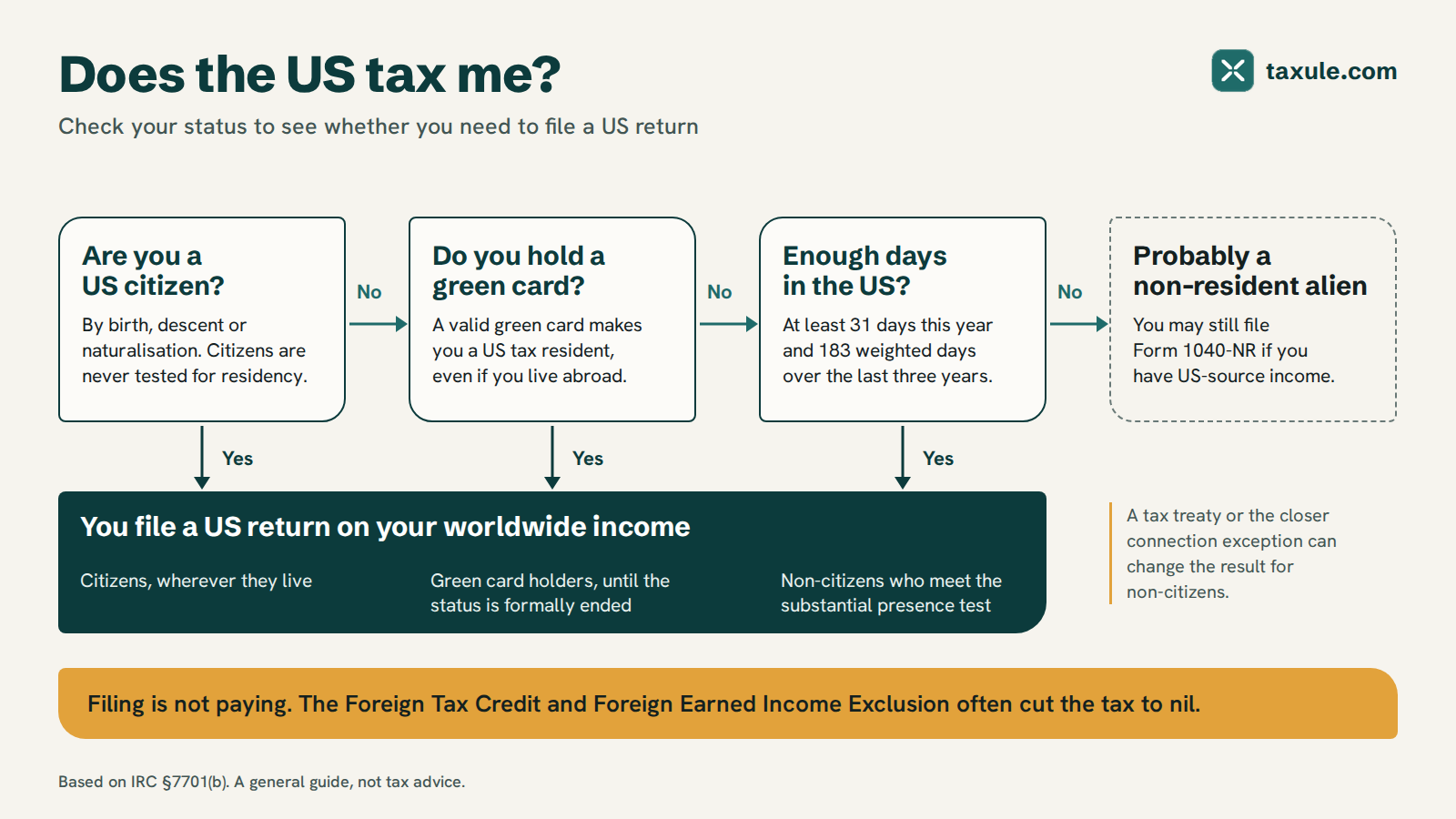
A green card keeps you a resident until you formally end that status. Leaving the US does not end it, and a long-term resident who gives one up can even face the exit tax covered below.
How do US taxes work for expats?
US taxes for expats run through the same system as everyone else's. There is no separate expat return: American living abroad taxes go on the standard Form 1040, and the taxation of American citizens living abroad follows the same rules as for anyone in the US.
You report your worldwide income on it; wages, self-employment profits, interest, dividends, rental income, capital gains and pension distributions, wherever it arises.
The forms most expats file
Form 1040 always, plus some combination of the forms below, depending on your income and accounts.
| Form | What it does | When it applies |
|---|---|---|
| Form 1040 | The main US tax return | Always, once income passes the filing threshold |
| Form 2555 | Excludes foreign earned income (up to $130,000 for 2025; $132,900 for 2026) | You have foreign earned income and meet the bona fide residence or physical presence test |
| Form 1116 | Claims the Foreign Tax Credit | You paid foreign income tax and want it credited against US tax |
| FinCEN Form 114 (FBAR) | Reports foreign bank and financial accounts | Foreign accounts total over $10,000 at any point in the year |
| Form 8938 | Reports foreign financial assets (FATCA) | Foreign assets exceed the FATCA thresholds for your status and location |
| Form 8621 | Reports certain foreign funds (PFICs) | You hold non-US mutual funds or similar investments |
For most people, expat filing US taxes means Form 1040 plus one or two of these. A typical American employed in the UK files Form 1040, claims the Foreign Tax Credit on Form 1116, and files an FBAR if their UK accounts crossed $10,000 at any point.
When are US taxes due for expats?
The deadlines match everyone else's, with one built-in allowance for living overseas. For the 2025 tax year, the original date was 15 April 2026.
If you are living abroad on the due date, you get an automatic two-month extension to 15 June, with no form required, you attach a short statement confirming you qualified.
Need longer? Form 4868 extends the deadline to 15 October, with a further date of 15 December available on request in some cases. The FBAR has its own automatic extension to 15 October.
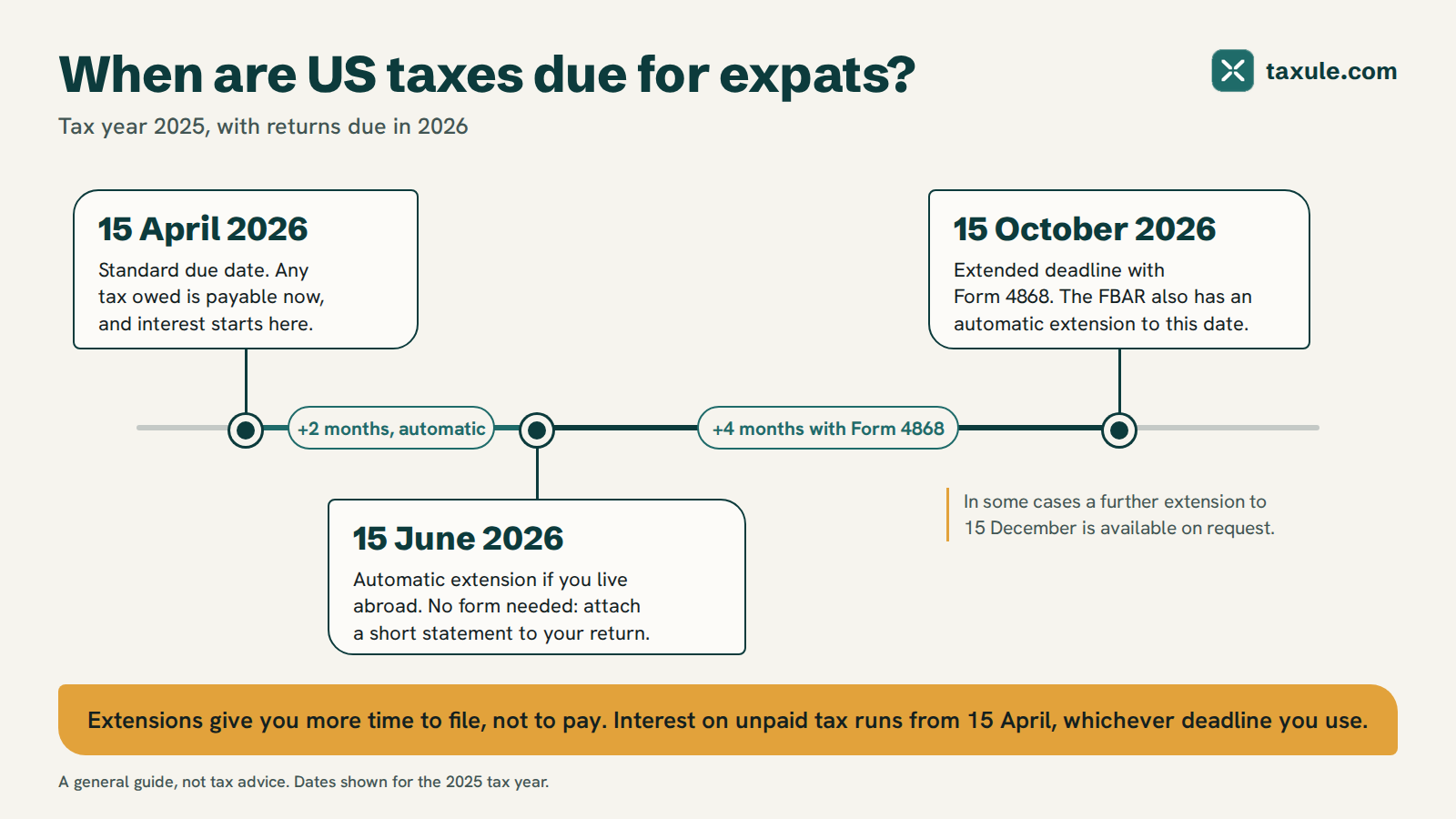
The catch is interest. Every one of these extends the time to file, not the time to pay. If you owe US tax, interest runs from 15 April whichever extension you use. Most people expat filing US taxes end in no bill, but if you expect to owe, pay an estimate by April to avoid it.
How Americans abroad avoid being taxed twice
Do Americans pay tax twice on the same income? Not if they claim the right tools. Three of them, the Foreign Earned Income Exclusion, the Foreign Tax Credit and tax treaties, do the work, and the trick is matching the tool to your situation.
Foreign Earned Income Exclusion (FEIE)
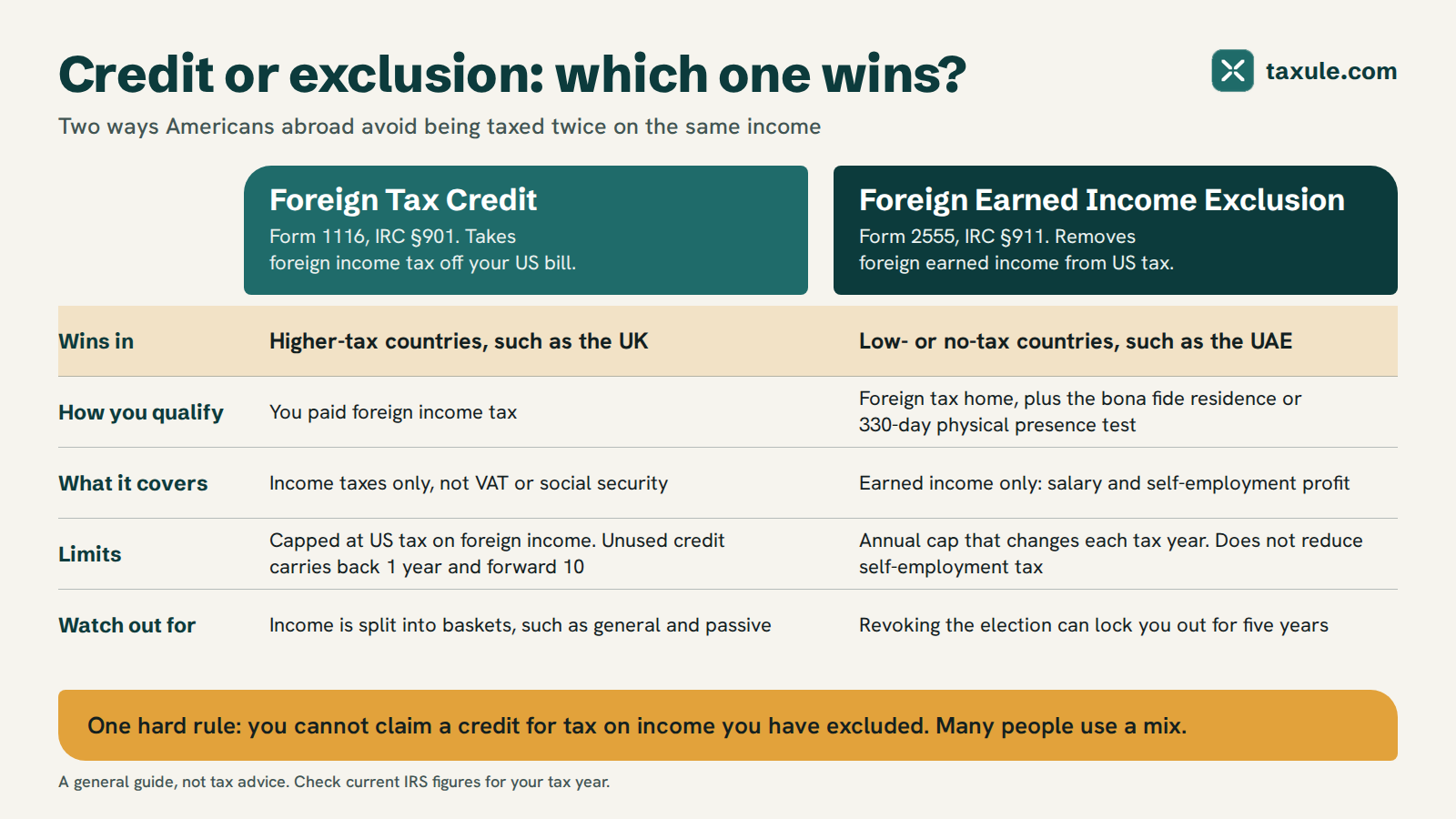
The FEIE, claimed on Form 2555 under IRC §911, excludes foreign earned income from US tax up to an annual cap: $130,000 for 2025, rising to $132,900 for 2026. You need a tax home abroad and must pass either the bona fide residence test or the physical presence test (330 full days abroad in any 12-month period).
Three limits matter: it covers earned income only (salary and self-employment profit), not interest, dividends, rent or gains; it does not reduce self-employment tax; and revoking the election can lock you out for five years without IRS consent.
A foreign housing exclusion or deduction can stack on top for qualifying housing costs, which helps in expensive cities like London.
Foreign Tax Credit (FTC)
The FTC, claimed on Form 1116 under IRC §901, takes the foreign income tax you paid off your US bill. It covers income taxes only, not VAT or social security, and is capped at the US tax due on your foreign-source income (IRC §904).
Income is sorted into separate baskets, such as general and passive, and unused credit can be carried back one year and forward ten. For an American in a high-tax country like the UK, the credit usually wipes out the US bill on a salary.
Tax treaties and totalization agreements
The US has income tax treaties with many countries, including the UK. Because of a "saving clause", treaties generally do not stop the US taxing its own citizens.
They still help with pensions, tie-breaker rules for residency, and income sourcing, which feeds into the credit; a treaty position may need disclosing on Form 8833.
Separate totalization agreements stop you paying social security to two countries on the same earnings, and a certificate of coverage proves which country you pay into.
Choosing between them
Broadly, the credit suits higher-tax countries and the exclusion suits low-tax ones, but it is not strictly either/or. The one hard rule: you cannot claim a credit for tax on income you have already excluded.
Same salary, two countries
Sarah, a US citizen, earns the equivalent of $120,000 as an employee. Figures are illustrative; the correct result depends on your facts.
| Item | UK (high-tax) | UAE (no income tax) |
|---|---|---|
| Foreign income tax paid | ~$34,000 | $0 |
| Best tool | Foreign Tax Credit | Foreign Earned Income Exclusion |
| How it works | UK tax credited against US tax | Salary excluded up to the cap |
| Typical US tax due | $0 (often with credit to carry forward) | $0 (salary within the cap) |
| Still files? | Yes — 1040, 1116 (+ FBAR if accounts > $10,000) | Yes — 1040, 2555 (+ FBAR if applicable) |
Same income, same nil result, reached through different forms. Pair them wrong and you can create a bill that need not exist.
Do US expats need to file state taxes?
Federal relief does not reach your state return. The FEIE and FTC are federal tools, so for anyone living overseas, US taxes can still include a state return decided by that state's own rules on domicile.
Most states stop taxing you once you genuinely move abroad and cut ties, closing accounts, surrendering a driving licence, registering to vote elsewhere. If you have clearly left, you usually have no further state obligation.
A handful make it much harder. California, New Mexico, South Carolina and Virginia are known for holding on to residents who keep ties like property, a licence or an intention to return. If you moved from one of these, check its specific rules rather than assuming the move ended things.
Reporting foreign accounts: FBAR and FATCA
American living abroad taxes can include two extra reports on top of the return if your foreign accounts are large enough.
FBAR (FinCEN Form 114) is required if the combined value of your foreign financial accounts tops $10,000 at any point in the year. It is filed electronically with FinCEN, not with your tax return.
Form 8938 (FATCA) is filed with your return. For taxpayers living abroad, the thresholds are $200,000 at year-end or $300,000 at any point for single filers, and $400,000 / $600,000 for joint filers (Treas. Reg. §1.6038D-2).
The two overlap, and many people in the UK file both. FATCA is also why a foreign bank may ask about your US status: under intergovernmental agreements, foreign financial institutions report US-linked accounts to the IRS.
What happens if a US citizen abroad doesn't file taxes?
You risk penalties and interest, lost tax benefits, and an IRS clock that never starts. In practice the biggest risks are usually the information-return penalties, not the tax itself.
Failure-to-file and failure-to-pay penalties run at 5% and 0.5% of unpaid tax per month, each capped at 25% (IRC §6651). If the exclusion or credit would have zeroed your bill, there may be little tax to penalise.
Information-return penalties are the sharp end. A missed Form 8938 carries a $10,000 penalty, rising by up to $50,000 for continued failure (IRC §6038D), and a wilful FBAR failure can reach the greater of a fixed sum or 50% of the account balance (31 U.S.C. §5321).
Lost tax benefits matter too, the FEIE and FTC must be claimed on a return, and late claims can be harder or, sometimes, lost.
The limitation period stays open. The usual time limit for the IRS to assess tax does not start until a return is filed (IRC §6501(c)(3)), and for some unfiled international forms it can stay open under §6501(c)(8).
Serious tax debt can even lead to passport restrictions (IRC §7345).
The good news: catching up is usually possible. The Streamlined Foreign Offshore Procedures let non-wilful filers abroad file three years of returns and six years of FBARs with a certification of non-wilfulness (Form 14653), usually penalty-free. If the failure was wilful, or an IRS examination has begun, different rules apply — get advice before filing anything.
Behind on your US tax returns?
We run Streamlined catch-up filings for Americans abroad who have missed returns or FBARs, and we will tell you which route fits your situation.
Talk to us about catching upLiving overseas, US taxes in three common scenarios
A US citizen abroad tax position usually fits one of three patterns, and the right mix of relief follows from which one you are in.
1. Employed in a high-tax country (e.g. the UK)
You earn a salary, pay UK income tax through PAYE, and hold a UK bank account. You file Form 1040 and claim the Foreign Tax Credit on Form 1116.
Because UK tax on your salary is generally higher than the US tax on it, the credit usually wipes out your US bill, and you may build excess credit to carry forward. If your UK accounts topped $10,000, you also file an FBAR. In most years you file and owe nothing.
2. Living in a low- or no-tax country
You work somewhere with little or no income tax, such as the UAE. The Foreign Tax Credit is worth little, because there is almost no foreign tax to credit.
Instead you claim the Foreign Earned Income Exclusion on Form 2555, up to the annual cap. Income above the cap may still be taxed, and you file an FBAR if your accounts crossed the threshold.
3. Wages plus foreign investments
You have a salary and also hold foreign shares, funds or rental property. The salary can be covered by the credit or the exclusion, but your investment income needs separate thought.
The exclusion does not cover it, UK funds can be treated as PFICs with heavy reporting (Form 8621), and Net Investment Income Tax (IRC §1411) may apply. This is where a return stops being simple and professional advice usually pays for itself.
When to get professional help
A simple case, one salary in one country, with the credit or the exclusion, can often be handled with good software and care. But expat filing US taxes gets harder fast, and US taxes for expats rarely stay simple once investments appear.
Consider an adviser if you:
- hold foreign investments or funds (PFIC territory),
- own a business or a share of one abroad,
- are drawing or moving a foreign pension,
- need to catch up on unfiled years, or
- are weighing renunciation and the exit tax.
These are the situations where the rules interact and benefits can be combined or lost. For United States expat taxes at that level, advice from someone who works across both US and local tax usually pays for itself, look for an Enrolled Agent (EA), CPA, or dual-qualified cross-border adviser.
The bottom line on American living abroad taxes
American living abroad taxes come down to three habits: file every year, claim the credit or exclusion that fits your income, and report your foreign accounts. Do those three and most Americans abroad owe little or nothing. Skip them and a simple obligation turns into penalties, lost benefits and an expensive catch-up.
US / UK cross-border tax service
We prepare your US return, pair the Foreign Tax Credit and Foreign Earned Income Exclusion correctly, handle FBAR and FATCA reporting, and run Streamlined catch-up filings for those behind.
Book a consultationFrequently asked questions
This article is for general information only and does not constitute tax advice. US federal and state rules, and the figures quoted, change regularly. Your circumstances may alter the outcome. Speak to a qualified US / cross-border adviser before acting.
One call. The right team, wherever you are.
Talk to a named adviser before your next filing or move fixed fee, no jargon, quoted before we start.