
The IRS statute of limitations on foreign income is 3 years from the date you file your return. Living abroad does not change that rule.
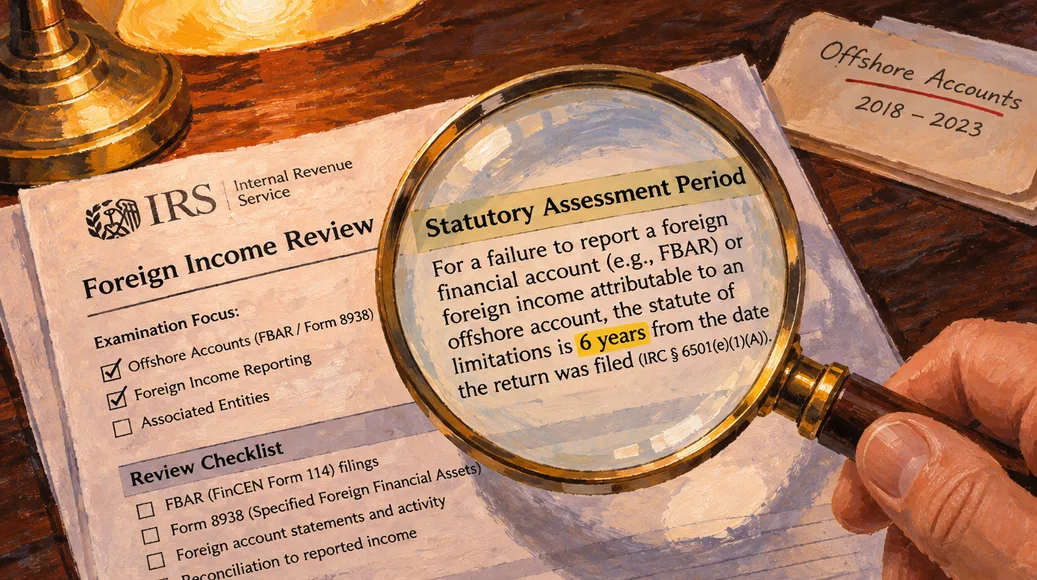
Leaving out more than 25% of your gross income, or more than $5,000 of income from foreign financial assets, gives the IRS 6 years. A missing foreign information return keeps the year open until 3 years after the IRS receives the information. Fraud, or no return at all, means no time limit.
IRS refund claims run 3 years from filing or 2 years from paying the tax, whichever ends later. Foreign tax credit claims run 10 years from the original due date of the return.
How long does the IRS have to assess tax on foreign income?
The IRS has 3 years after you file your return to assess tax on foreign income, the same period that applies to income earned in the US. Section 6501(a) of the Internal Revenue Code sets one assessment period for all income, with no separate period for foreign income. It applies whether or not you filed the return on time, so a late return still starts its own 3-year period from the date you file it.
Your foreign salary, foreign rental profits, dividends from foreign shares and gains on foreign assets all fall inside the same period as your US income. Three years is the general rule, and the exceptions below lengthen it.
When does the 3-year period start?
The period runs from the date you filed the return. A return you file early counts as filed on its due date, so filing in February gains you no time against a mid-April due date. A return the IRS prepares for you, known as a substitute for return, never starts the period at all.
When does the 6-year IRS statute of limitations apply?
The IRS gets 6 years when you leave out more than 25% of your income, more than $5,000 of income from foreign financial assets, or any Subpart F income. Any one of these 3 triggers is enough:
- You leave out more than 25% of the gross income shown on your return. The test compares the omitted amount with the gross income stated on the return itself.
- You leave out more than $5,000 of income from foreign financial assets. Assets of the kind reported on Form 8938, the form for assets under section 6038D, count even when your total sits below the Form 8938 threshold.
- You leave out Subpart F income from a controlled foreign corporation. Any amount omitted under section 951(a) triggers the 6 years, with no minimum amount.
Form 8938 covers foreign stock or securities you hold outside a financial account, so income from them falls inside the second trigger. An item you disclose adequately does not count as omitted for the 25% test or the $5,000 test. Adequate disclosure means stating its nature and amount on the return or in a statement attached to it.
Can a missing foreign information return keep the statute of limitations open?
Yes. A missing foreign information return keeps the assessment period for that year open until 3 years after the IRS receives the missing information. The rule sits in section 6501(c)(8) of the Internal Revenue Code, and it covers the return, event or period that the information relates to. The year does not stay open forever, because it closes 3 years after the information reaches the IRS. The information-return penalties behind this are a separate question from how long the year stays open.
The rule covers information required under sections 1295(b), 1298(f), 6038, 6038A, 6038B, 6038D, 6046, 6046A and 6048. You file Form 8938 under section 6038D, so a missing Form 8938 keeps the year open.
Does reasonable cause limit the open period?
Yes. Reasonable cause, with no willful neglect, narrows the open period to the items related to the missing information. If Lena had reasonable cause for the missing form, only the Form 8938 items would stay open after June 1, 2026, and the rest of her 2022 return would close on that date.
When does the IRS have no time limit to assess tax?
The IRS has no time limit when a return is fraudulent, when no return is filed, or when the only return is one the IRS prepared. Any one of these 3 cases leaves the IRS with no time limit:
- A false or fraudulent return filed to evade tax.
- No return filed for the year.
- A return the IRS prepared for you (substitute for return). A return prepared under section 6020(b) never starts the 3 years.
Filing your own return starts the 3-year clock in the no-return and substitute-for-return cases. A fraudulent return keeps the year open, even if you later file a correct one.
How do you start the IRS 3-year clock on foreign income?
To start the IRS 3-year clock on foreign income, file your own return, submit every required foreign information return, and report or disclose all of it. Three steps start the clock:
- File your own income tax return. The 3 years run from the date you file, and a return the IRS prepares for you does not count.
- Submit every foreign information return you must file. A missing return keeps the year open until 3 years after the IRS receives it.
- Report all foreign income, or disclose it on the return. An amount disclosed in a way that tells the IRS its nature and amount does not count as omitted for the 25% test or the $5,000 test.
Can the IRS extend the time limit to assess tax?
The IRS can extend the time limit to assess tax only when you and the IRS both agree in writing before the period ends. Once an agreement is in place, you and the IRS can agree again before that extended period expires.
You have 2 options each time the IRS asks. You can refuse to sign, or you can agree to a limited extension that covers only particular issues or only a set period. The IRS must tell you about both rights every time it asks, under section 6501(c)(4) of the Internal Revenue Code.
How long do you have to claim an IRS refund on foreign income?
You have 3 years from filing or 2 years from paying the tax, whichever ends later, to claim a refund, with longer periods for foreign tax credits and worthless debts or securities. Three refund periods apply, and the table shows when each one starts:
| Refund claim | Time limit | Runs from |
|---|---|---|
| Most refunds | 3 years from filing or 2 years from payment, whichever is later | The filing date or the payment date |
| Refunds from a foreign tax credit | 10 years | The original due date of the return for the year the foreign taxes were paid or accrued |
| Refunds for a bad debt or a worthless security | 7 years | The original due date of the return for that year |
Filing no return for the year leaves you 2 years from the date you paid the tax, under section 6511 of the Internal Revenue Code. The 10-year and 7-year periods run from the original due date of the return, and an extension does not move that date.
How long should you keep tax records when you have foreign income?
Keep your records for as long as the year can stay open. The IRS says to keep records for:
- 3 years generally.
- 6 years if unreported income is more than 25% of gross income.
- 7 years for a worthless securities or bad debt claim.
- Indefinitely if you filed no return or a fraudulent one.
How long can the IRS collect tax after it is assessed?
The IRS generally has 10 years from the date it assesses tax to collect it, a period separate from the time limit to assess. The two clocks run one after the other. The assessment period decides whether the IRS can still assess the tax, and then section 6502 of the Internal Revenue Code gives it 10 years from the assessment date to collect tax assessed in time.
How long does the IRS have to assess FBAR penalties?
FBAR penalties follow a separate 6-year limit in Title 31 of the US Code, not the tax rules in section 6501. The 6 years begin on the date of the transaction, under 31 U.S.C. 5321. Once a civil FBAR penalty has been assessed, a court case to recover it may start within 2 years after the later of the assessment or a related final criminal judgment.
Filing your tax return does not start the FBAR period. The FBAR is a separate report, filed with FinCEN through the BSA E-Filing System rather than with your federal tax return.
IRS statute of limitations on foreign income FAQs
Help with the IRS statute of limitations on foreign income
The right help with the IRS statute of limitations on foreign income depends on where you live and whether you are behind on filings.
Tell us how the business is built.
A short set of questions about structure, people and where you trade. We come back with a scope and a fixed price. If we are not the right firm for you, we will say so rather than quote for it.