
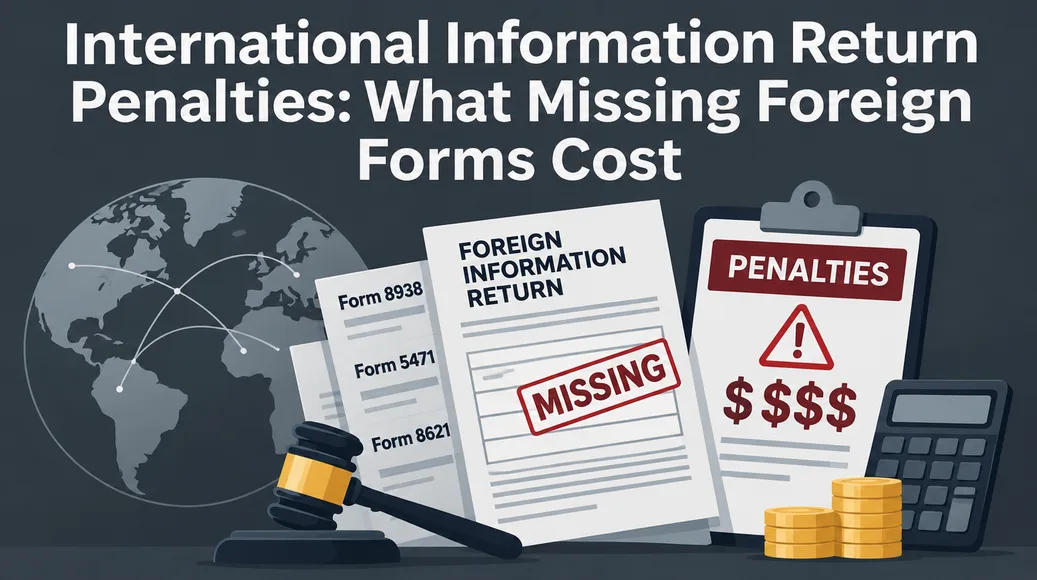
An international information return penalty starts at $10,000 per form for most foreign reporting forms, even when you owe no US tax. Form 5472 carries $25,000, and foreign trust and gift penalties can be a percentage of the unreported amount. The IRS can remove or reduce some of these penalties for reasonable cause, meaning you acted responsibly and the failure came from circumstances beyond your control.
The Internal Revenue Code imposes these civil penalties when a foreign information return is late, incomplete or wrong. The penalties reach owners of foreign companies, partners in foreign partnerships, people with foreign trusts or large foreign gifts, holders of foreign financial assets above the Form 8938 threshold, and 25% foreign-owned US corporations. Continuation penalties, which add more for each 30-day period a form stays unfiled, start 90 days after an IRS notice, and a missing form can keep the IRS's time limit to assess tax open. The IRS assesses some of them by computer when a late Form 5471 or 5472 arrives with an original Form 1120 or 1065.
What are international information return penalties?
International information return penalties are civil penalties the IRS charges when a required foreign information return is late, incomplete or incorrect. The law that sets them is Title 26 of the US Code, the Internal Revenue Code. The IRS lists the forms and the amounts on its international information reporting penalties page. They apply to people with foreign financial assets, a foreign business interest, or financial activity from a foreign source.
Six forms carry most of these penalties: Form 5471, Form 5472, Form 8865, Form 3520, Form 3520-A and Form 8938. Each one reports a foreign holding or transaction rather than income, so the penalty applies to the paperwork itself. The National Taxpayer Advocate reports that many of these penalties bear no relation to any taxable income or tax owed. A return showing no tax due therefore still attracts the full amount.
Is the FBAR an international information return?
No. The FBAR (FinCEN Form 114) goes to FinCEN through the BSA E-Filing System, not with your tax return. Its civil penalties are adjusted for inflation each year. The IRS sets the two side by side in its comparison of Form 8938 and FBAR requirements. FBAR penalties therefore sit outside the IRS information return penalties on this page.
Who can be charged an international information return penalty?
An international information return penalty can be charged to any US person, or 25% foreign-owned US corporation, that misses a required foreign form. Five common situations follow.
- You own or run a foreign corporation (Form 5471). Form 5471 reaches officers, directors and shareholders in certain foreign corporations.
- You hold an interest in a foreign partnership (Form 8865). Form 8865 reaches certain US persons with interests in foreign partnerships.
- You deal with a foreign trust or receive a large foreign gift (Form 3520 and Form 3520-A). These forms reach US persons and executors with foreign trust transfers, distributions or ownership, and those who receive certain foreign gifts.
- Your foreign financial assets pass the Form 8938 threshold (Form 8938). Form 8938 reaches specified individuals and specified domestic entities whose foreign financial assets pass the threshold.
- Your US corporation is 25% foreign-owned (Form 5472). Form 5472 reaches 25% foreign-owned US corporations and foreign corporations engaged in a US trade or business.
None of this is limited to large estates or large companies. The National Taxpayer Advocate reports that the IRS assesses 71% of individual IRC 6038 penalties against taxpayers reporting under $400,000 of income.
How much is the international information return penalty for each form?
The penalty for each form is $10,000 for most forms, $25,000 for Form 5472, and a percentage of the unreported amount for foreign trusts and gifts. The table covers 8 cases. The third column is the continuation penalty, which runs for each 30-day period after an IRS notice. The fourth is the ceiling on that continuation penalty.
| Form | Initial penalty | Continuation after IRS notice | Limit |
|---|---|---|---|
| Form 5471 | $10,000 per failure | $10,000 per 30-day period | Continuation up to $50,000 |
| Form 5472 | $25,000 per failure | $25,000 per 30-day period | No maximum |
| Form 8865 | $10,000 per failure (for unreported contributions, 10% of the property's value, capped at $100,000 unless the failure is due to intentional disregard) | $10,000 per 30-day period | Continuation up to $50,000 |
| Form 3520, Parts I and III (foreign trust transfers and distributions) | Greater of $10,000 or 35% of the unreported amount | $10,000 per 30-day period | Total cannot exceed the unreported amount |
| Form 3520, Part II (US owner of a foreign trust) | Greater of $10,000 or 5% of the unreported trust assets | $10,000 per 30-day period | Total cannot exceed the unreported trust assets |
| Form 3520, Part IV (foreign gifts) | 5% of the gift's value per month or part of a month | None | 25% of the gift's value |
| Form 3520-A | Greater of $10,000 or 5% of the gross value of the owner's share of trust assets | $10,000 per 30-day period | Total cannot exceed the value of the owner's trust assets |
| Form 8938 | $10,000 | $10,000 per 30-day period | Continuation up to $50,000 |
These figures apply per form and per failure. The IRS can reduce or remove some of them for reasonable cause.
How do continuation penalties build on international information returns?
The continuation penalty starts 90 days after the IRS mails a notice, then adds $10,000 for each 30-day period the form stays unfiled until you file it or reach the cap. For Form 5471 and Form 8865, the continuation penalty stops at $50,000. The 90 days run from the date on the notice. Filing inside that window avoids the continuation penalty.
Form 5472 works the same way but costs more and has no ceiling. Each 30-day period after the 90 days adds $25,000, and the continuation penalty keeps running until you file a complete and correct return.
What else can a missing international information return cost?
A missing foreign form can keep the IRS's time limit to assess tax open until 3 years after you file the form, and some failures also reduce your foreign tax credit. Under IRC 6501(c)(8), when required information goes unreported under sections such as 6038, 6038A, 6038B, 6038D, 6046 or 6048, the time to assess tax for that return, event or period does not end before 3 years after the information is furnished. If the failure was due to reasonable cause and not willful neglect, the longer period applies only to the items related to the failure.
Section 6038 also reduces the foreign tax credit when the required information is not filed. The reduction applies to both Form 5471 and Form 8865, so one failure can raise the tax bill and the penalty bill together.
Form 8938 carries its own second cost. When an understatement of tax comes from an undisclosed specified foreign financial asset, section 6662(j) raises the accuracy-related penalty on that part of the understatement to 40%, in addition to the Form 8938 penalty.
The IRS also charges interest on the penalty itself. Interest comes off only if the penalty is removed or reduced.
Does the IRS charge international information return penalties automatically?
The IRS charges some of these penalties automatically: its computer system assesses the penalty when a late Form 5471 or 5472 arrives with an original Form 1120 or 1065, before anyone at the IRS reviews it. The IRS told the National Taxpayer Advocate that penalties on Form 8938, Form 8865 and Form 5471 attached to a Form 1040 come through an examination, where the examiner considers reasonable cause before assessing. For the computer-assessed penalties, you may need to answer IRS letters and resubmit your statement.
Forms 3520 and 3520-A are the exception, and only since late 2024. The IRS stopped assessing those penalties automatically in October 2024 and updated its Internal Revenue Manual in November 2024. It now reads a reasonable cause statement attached to a late Form 3520 or 3520-A before it assesses any penalty.
Courts disagree on whether the IRS may assess some of these penalties at all. In May 2024 the Court of Appeals for the DC Circuit held in Farhy v. Commissioner that the Form 5471 penalty under section 6038(b) is an assessable penalty, reversing the Tax Court, and refused to rehear the case the following month. The Second Circuit reached the same result in Safdieh v. Commissioner in February 2026. The Tax Court has kept to its own contrary view in cases appealable to other circuits, so where you live affects whether that argument is open to you. The argument concerns how the IRS collects the penalty, not whether the form was due.
How can you get an international information return penalty reduced or removed?
To get an international information return penalty reduced or removed, show reasonable cause: you acted responsibly, and the failure came from significant reasons or circumstances beyond your control. Four steps follow.
- File the missing form through normal filing procedures, before the IRS contacts you if you can. People who are not under IRS civil examination or criminal investigation, and who have not yet been contacted by the IRS about the forms, file late returns through normal filing procedures. Penalties may still be assessed. Late forms other than Forms 3520 and 3520-A go with an amended income tax return.
- Attach a reasonable cause statement to each late form. Reasonable cause means acting responsibly before and after the failure and having significant reasons or circumstances beyond your control. Not all international information reporting penalties qualify for relief on that basis.
- Answer every IRS letter and resubmit your reasonable cause statement if asked. The statement you attached may not have been read before the penalty was assessed, so the IRS may want it a second time.
- Dispute the penalty by phone or letter, or pay and claim a refund on Form 843. Call the number on the notice or write a letter. After paying, claim the refund on Form 843.
The IRS abates many assessed penalties. According to the National Taxpayer Advocate, the IRS later abated 74% by number and 84% by dollar value of the IRC 6038 and 6038A penalties it assessed automatically from 2018 to 2021. Penalties an examiner assessed by hand came off less often, at 27% by number and 16% by dollar value. The National Taxpayer Advocate also reports that the IRS issues no notice of deficiency for these penalties, so a court challenge on the merits generally comes only after you pay in full, in a US district court or the US Court of Federal Claims.
People who also left foreign income off a return use a different route, such as the Streamlined Filing Compliance Procedures or the Voluntary Disclosure Practice. The IRS lists both as offshore compliance options alongside its delinquent international information return submission procedures.
The IRS's general penalty waivers do not cover these penalties. First Time Abate never applied to them on their own, and the Automatic Exemption from Penalty that began replacing it in 2026 does not either. That exemption covers failure-to-file, failure-to-pay and failure-to-deposit penalties, and the IRS says information returns are generally not eligible. For Forms 5471, 5472, 8865, 3520, 3520-A and 8938, reasonable cause remains the route.
International information return penalty FAQs
Where to get help with international information return penalties
Where to get help with international information return penalties depends on where you live. Pick the option below that matches.
Where to go next
Tell us how the business is built.
A short set of questions about structure, people and where you trade. We come back with a scope and a fixed price. If we are not the right firm for you, we will say so rather than quote for it.