
US citizens and resident aliens living abroad may need to make quarterly estimated tax payments when their US federal tax liability is not fully covered by withholding and tax credits. Foreign salaries, self-employment income, rental profits and investment income can create this obligation even when the taxpayer pays income tax in another country.
For 2026, estimated payments are generally required when you expect to owe at least $1,000 in US federal tax after withholding and refundable credits, and your withholding does not meet the required annual payment threshold.
The foreign earned income exclusion (FEIE), foreign tax credit (FTC) and totalization agreements can reduce or eliminate certain US tax liabilities, but each applies differently.
Which US expats need to make estimated tax payments?
US citizens and resident aliens generally remain subject to federal estimated tax rules while living overseas. This includes green card holders who remain US tax residents, although individual residency and treaty circumstances can affect their status.
Americans abroad must consider their worldwide taxable income, including foreign wages, self-employment profits, rental income and investments. Estimated payments may need to cover income tax, self-employment tax and other applicable federal taxes when US withholding is insufficient.
There are two conditions that generally determine whether estimated payments are required.
The $1,000 test after withholding and refundable credits
The first condition is that you expect to owe at least $1,000 in federal tax for 2026 after subtracting US income tax withholding and refundable credits.
For expatriates, the distinction between foreign tax payments and US withholding is important. Income tax paid to another country does not count as US withholding. However, an eligible foreign tax credit can reduce the US income tax liability used to determine whether you reach the $1,000 threshold.
For example, a US citizen working for a foreign employer may have no US tax withheld from their salary. If the FEIE and foreign tax credit do not fully cover their US income tax, estimated payments may be necessary.
Self-employed expats must also include any US self-employment tax they expect to owe, even where the FEIE reduces their income tax to zero.
The Required Annual Payment Test
The second condition applies when your expected US withholding and refundable credits are less than the required annual payment.
For 2026, the required annual payment is generally the smaller of:
- 90% of your expected 2026 tax liability, or
- 100% of your 2025 tax liability, provided your 2025 return covered a full 12 months.
The prior-year percentage increases to 110% if your 2025 adjusted gross income (AGI) exceeded $150,000, or $75,000 if your 2026 filing status is married filing separately.
These thresholds are particularly relevant to expats whose foreign income fluctuates because of exchange rates, overseas bonuses or changes in employment. Using the prior-year amount can provide a predictable payment target when current-year income is uncertain.
Meeting the required payment amount by the applicable deadlines generally protects you from the estimated tax underpayment penalty, though you may still owe a balance when you file your return.
When does the no-liability exception apply?
You generally do not need to make estimated tax payments for 2026 if you had no US federal income tax liability for the full 2025 tax year and were a US citizen or resident alien throughout that year.
For example, an American living abroad whose 2025 US tax liability was reduced to zero by available exclusions and credits may qualify for this exception, provided the other conditions are met.
A tax refund does not necessarily mean you had no tax liability. Check the total tax shown on your previous return rather than the refund received.
The exception does not apply where the previous tax year was shorter than 12 months or the taxpayer did not have qualifying US citizenship or residency status throughout that year.
Income that commonly creates a shortfall for taxpayers abroad
Americans living abroad often receive income without US federal tax withholding. Whether that income creates an estimated payment obligation depends on the remaining US tax liability after applicable exclusions, deductions and credits.
The following income sources can create a shortfall:
- Self-employment and freelance profits. Expats working for themselves generally receive payments without US federal tax withholding. The FEIE may reduce income tax on qualifying foreign earnings, but it does not eliminate US self-employment tax. An applicable totalization agreement may provide an exemption.
- Foreign employer wages. Foreign employers often do not withhold US federal income tax. Where the FEIE and foreign tax credit do not fully offset the US income tax on those wages, estimated payments may be necessary.
- Dividends, interest and capital gains. Investment income generally does not qualify for the FEIE. Income from foreign investments may create a US tax liability without corresponding US withholding, while income reported by US brokers may also be insufficiently covered by withholding.
- Foreign rental income. Expats who own rental property overseas generally report the income on their US tax returns. Eligible foreign income taxes may reduce the resulting US liability through the foreign tax credit, but estimated payments may still be required.
- Partnership and S corporation income. Americans abroad who hold interests in US partnerships or S corporations may need to pay estimated tax on their share of taxable income, including amounts not distributed during the year.
- US pensions and retirement income. Pension payments, IRA distributions and taxable Social Security benefits can create a tax shortfall where federal withholding does not cover the recipient's final US liability.
How do FEIE, Foreign Tax Credit and Self-Employment Tax affect the estimate?
The foreign earned income exclusion, foreign housing relief and foreign tax credit can reduce the US income tax that an expatriate needs to cover through estimated payments. However, their effect depends on the type of income, the amount of relief available and when foreign taxes become creditable.
Expats should calculate estimated payments using the exclusions and credits they reasonably expect to claim for 2026. Overestimating these reliefs can create an underpayment if the final US tax liability is higher than expected.
Foreign Earned Income and Housing Exclusions
The foreign earned income exclusion (FEIE) allows qualifying Americans abroad to exclude eligible foreign earnings from US income tax, up to $132,900 for 2026. Eligible foreign housing expenses may provide additional relief through the foreign housing exclusion or deduction.
However, the FEIE does not necessarily eliminate US income tax on earnings above the exclusion limit. Under the stacking rule, excluded foreign earned income remains relevant when determining the tax rate applied to income that is still taxable.
Expats should account for this rule when calculating their expected US tax using the Foreign Earned Income Tax Worksheet in IRS Publication 505.
Assume a single filer in 2026 with no other income and no foreign tax, with foreign wages of $150,000, the full foreign earned income exclusion of $132,900 and the standard deduction of $16,100. Taxable income is $1,000. Working from the 2026 Tax Rate Schedules in Form 1040-ES, tax on $133,900 is $24,734 and tax on $132,900 is $24,494.
US tax on the return is the difference, $240, not the $100 that a 10% bracket calculation would suggest, because the remaining $1,000 is stacked on top of the excluded income and taxed in the 24% bracket. The figures are illustrative.
This filer is well under the $1,000 threshold and needs no estimated tax payments on these facts.
Expats who have not yet satisfied the bona fide residence or physical presence test should also consider the risk of losing FEIE eligibility. Changes to an overseas assignment or the number of days spent in a foreign country may affect the exclusion claimed and increase the US tax liability used to calculate estimated payments.
Foreign Tax Credit
The foreign tax credit (FTC) can reduce the US income tax payable on income that has also been taxed abroad. However, the credit does not reduce US self-employment tax.
The timing of foreign tax payments can affect an expatriate's estimated US tax calculation. Foreign income taxes are generally creditable in the year paid or accrued, depending on the taxpayer's accounting method and applicable election.
For example, an expat who claims foreign tax credits when taxes are paid may face a US tax shortfall if a foreign tax payment is not made until the following calendar year. The expected credit for 2026 should therefore reflect the foreign taxes that will qualify for credit on the 2026 US return.
The credit is also subject to limitations, so paying foreign income tax does not automatically eliminate US income tax on the same earnings. In addition, foreign tax credits generally do not offset the Net Investment Income Tax, which may need to be included separately in the estimated tax calculation.
Self-employment Tax and Totalization Agreements
US citizens who work for themselves abroad may owe US self-employment tax even when the FEIE eliminates their income tax. Self-employment tax generally includes Social Security and Medicare contributions calculated on net earnings from self-employment.
For 2026, self-employment earnings are generally subject to a combined Social Security and Medicare rate of 15.3%, with the Social Security component subject to an annual earnings limit.
Example: a self-employed expat with $60,000 in annual net profit. Assume a US citizen earns $60,000 in net self-employment profit while living overseas, has no other earnings affecting the calculation and does not qualify for an exemption under a totalization agreement.
The self-employment tax calculation uses 92.35% of net profit, producing net earnings of $55,410. Applying the combined 15.3% rate gives approximately $8,478 in US self-employment tax.
Even if the FEIE eliminates the individual's income tax, the self-employment tax alone exceeds the $1,000 estimated payment threshold.
How totalization agreements affect the calculation
A totalization agreement between the United States and another country can prevent double social security taxation. Depending on the agreement and the individual's circumstances, an expat may be covered by the foreign country's social security system instead of the US system.
Where the agreement exempts the individual from US self-employment tax, the exemption can substantially reduce the estimated US tax liability. The taxpayer generally needs appropriate evidence of the applicable social security coverage, such as a certificate of coverage, to support the exemption.
How to calculate estimated US tax on foreign income?
Expats can estimate payments using the previous year's tax liability, their expected current-year liability, or the annualised income method for uneven earnings.
The calculation should include all taxable income, applicable FEIE and housing relief, expected foreign tax credits, self-employment tax and US tax withholding. Foreign-currency amounts must be converted into US dollars using appropriate exchange rates.
IRS Form 1040-ES provides the estimated tax worksheet for calculating the required annual payment.
Prior-year method
The prior-year method uses 100% of your 2025 federal tax liability, or 110% if your 2025 adjusted gross income exceeded the applicable higher-income threshold. The previous return must cover a full 12-month tax year.
This method can suit expatriates whose foreign earnings fluctuate because of exchange rates, employment changes or variable business income.
For example, assume an expat had a qualifying 2025 federal tax liability of $10,000, an AGI below the higher-income threshold and no expected US withholding in 2026. The prior-year method gives a payment target of $10,000, normally divided into four instalments of $2,500.
Even if the individual's actual 2026 tax liability rises to $15,000, making the required payments on time generally protects against the estimated tax penalty. The remaining $5,000 would still be payable when the return is filed.
Current-year method
The current-year method uses 90% of your expected 2026 federal tax liability, after accounting for applicable exclusions, deductions and credits.
For expats, this means estimating foreign wages, self-employment profits, investment income and other taxable earnings, then calculating the expected US tax after FEIE, foreign housing relief and foreign tax credits.
The method can be useful where foreign earnings have fallen significantly since 2025 or the previous year's tax liability was unusually high.
For example, an expat expecting a 2026 US tax liability of $7,000 after applicable reliefs would have a current-year payment target of $6,300 before withholding adjustments. With no withholding and four equal instalments, this would generally mean payments of $1,575.
The main risk is underestimating foreign income or overestimating tax relief. Changes in income, exchange rates or foreign tax credits may require the remaining instalments to be recalculated.
Annualised income instalment method
The annualised income method can help expats whose taxable income arises unevenly during the year.
For example, an American working overseas may receive a substantial annual bonus in December, begin foreign self-employment part-way through the year or realise a large investment gain late in the year.
Instead of assuming that taxable income arises evenly throughout the year, this method calculates the required instalments using income and deductions for specified cumulative periods.
Expats using this method must calculate their payments under Schedule AI of Form 2210 and file the relevant form with their US tax return.
The annualised method can reduce or eliminate an underpayment penalty for an earlier period when the income that created the tax liability had not yet arisen.
Using US withholding instead of quarterly payments
Expats who receive income subject to US federal withholding may be able to reduce or avoid estimated tax payments by increasing the amount withheld.
This can be particularly useful for Americans abroad who receive US wages, pensions, IRA distributions or taxable Social Security benefits.
Federal income tax withholding is generally treated as paid evenly across the four estimated tax instalment dates, even when additional tax is withheld later in the year. This can help correct an earlier estimated payment shortfall.
For example, assume an expatriate needs $12,000 in annual tax payments to avoid an underpayment penalty. Their regular US withholding covers $8,000, and an additional $4,000 is withheld from a US pension during November and December.
Under the usual even-treatment rule, the combined $12,000 withholding is treated as $3,000 paid towards each instalment date. This can protect against earlier underpayments that would not necessarily be corrected by making a late estimated tax payment.
Depending on the income source, additional withholding can be arranged using Form W-4 for US wages, Form W-4P for periodic pensions, Form W-4R for certain retirement distributions or Form W-4V for eligible government payments.
Special consideration for pensioners abroad
US citizens and resident aliens generally cannot elect zero withholding on applicable pension distributions delivered outside the United States. However, adjustments to the amount withheld may be possible under the relevant withholding rules.
Expats whose foreign employment income is not subject to US withholding will generally need to use estimated payments if their expected tax liability meets the payment requirements.
Estimated tax due dates for 2026 and the expat extension
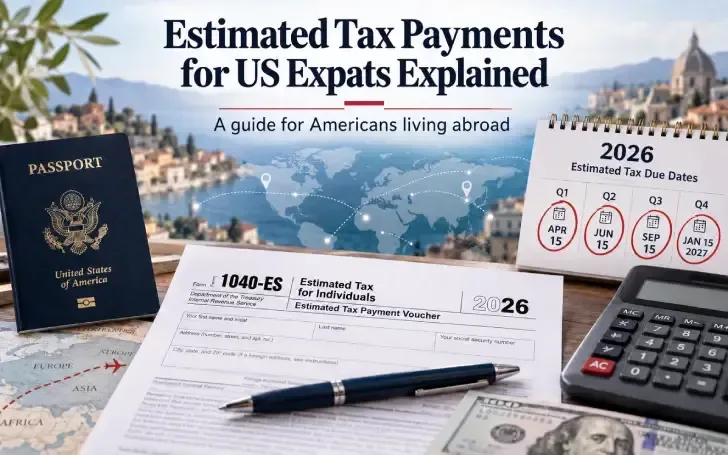
The 2026 installment schedule is:
| Installment | Income period | Due date |
|---|---|---|
| 1 | 1 January to 31 March 2026 | 15 April 2026 |
| 2 | 1 April to 31 May 2026 | 15 June 2026 |
| 3 | 1 June to 31 August 2026 | 15 September 2026 |
| 4 | 1 September to 31 December 2026 | 15 January 2027 |
These payment periods are not equal calendar quarters. For example, income arising in June falls within the third payment period, which has a 15 September 2026 deadline. Expats making payments from overseas should allow sufficient time for bank processing and international transfers. Payments made through foreign banks may take longer to reach the IRS. The fourth instalment may not be necessary if you file your 2026 Form 1040 by 1 February 2027 and pay the entire outstanding balance by that date. This exception applies only to the fourth instalment.
Why does the June 15 extension not move the instalment dates
Qualifying US citizens and resident aliens living abroad generally receive an automatic two-month extension to file their federal income tax returns. For the 2026 tax year, this moves the normal filing deadline from 15 April 2027 to 15 June 2027. However, the extension does not change the quarterly estimated tax payment deadlines. An expat who needs to make a 2026 estimated tax payment must still follow the applicable instalment dates, even if their 2026 Form 1040 is not due until June 2027. Interest generally applies to any unpaid annual tax balance from the normal 15 April return deadline, even where the automatic expatriate extension applies. The estimated tax underpayment penalty is a separate charge that can arise when required instalments were not paid on time.
How to pay estimated tax from outside the United States
Americans living abroad can make federal estimated tax payments electronically or through certain alternative payment methods. All payments must reach the IRS in US dollars.
The available options depend mainly on whether you have access to a US bank account.
Paying from a US bank account
Expats who maintain a US bank account can generally use IRS Direct Pay, their IRS Online Account or the Electronic Federal Tax Payment System (EFTPS).
IRS Direct Pay and Online Account payments require eligible US banking details. EFTPS requires enrolment before payments can be made.
These options allow taxpayers to make payments without arranging international bank transfers.
Paying without a US bank account
Expats who do not maintain a US bank account may be able to pay by debit card, credit card, supported digital wallet or international wire transfer.
Card payments are processed through IRS-approved providers, which charge transaction fees. Acceptance of foreign-issued cards depends on the payment provider.
International wire transfers are also available from foreign banks that can route payments through a US banking institution. The IRS requires the correct tax type code, tax period and payment information to ensure the funds are allocated properly.
International wires may involve bank charges, exchange-rate costs and processing delays. Expats should arrange payment sufficiently early to meet the applicable US deadline.
Paying by cheque or money order
The IRS also provides Form 1040-ES payment vouchers for eligible payments by US-dollar cheque or money order.
However, international postage and payment-processing delays can make this less practical for expats. Electronic payment is generally preferable where an accessible method is available.
Making sure the IRS records your payment correctly
Each estimated payment should identify the correct taxpayer, tax year and payment type. Keep the payment confirmation number, amount, date and any foreign-currency conversion records.
If you are married to a nonresident alien, additional restrictions may apply to joint estimated tax payments. Whether joint payments are permitted depends on the couple's US tax status and any applicable election to treat the nonresident spouse as a US resident.
What happens if an expat misses an estimated tax payment?
The IRS may charge an estimated tax underpayment penalty when an expatriate fails to pay enough tax by the required instalment deadlines. The penalty is calculated separately for each underpaid instalment and generally depends on the unpaid amount, the applicable underpayment rate and how long the shortfall remains outstanding. An expat can therefore face an underpayment penalty even when the final US tax return shows a refund.
Common reasons expats underpay estimated tax
Several overseas circumstances can create an unexpected shortfall:
- Foreign income increases. A salary increase, overseas bonus or higher business profits may create more US tax than originally estimated.
- Foreign tax credits are lower than expected. Differences in foreign tax payment timing, credit eligibility or the amount of foreign tax can increase the final US liability.
- FEIE eligibility changes. An expat who fails to meet the relevant residence or physical presence requirements may lose an exclusion used in the original estimate.
- Self-employment tax is overlooked. The FEIE does not eliminate US self-employment tax, and an applicable totalization agreement exemption must be supported by the individual's circumstances.
Can expats obtain relief from the penalty?
Living outside the United States does not, by itself, exempt a taxpayer from estimated tax underpayment penalties. The IRS may waive the penalty in certain circumstances, including qualifying casualty, disaster or unusual events. A separate waiver may apply where an individual retired after reaching age 62 or became disabled during the current or preceding tax year, provided the relevant conditions are met. Expats with uneven income may also benefit from the annualised income instalment method, which can reduce the penalty for periods before the income arose. Form 2210 is used when taxpayers need to calculate or claim certain adjustments or waivers. In other cases, the IRS can generally calculate the penalty.
What should you do if you miss a payment?
Make the outstanding payment as soon as possible to limit further underpayment charges. Then review your remaining estimated payments using updated foreign income, US tax and foreign tax credit figures. If you receive US income subject to federal withholding, increasing that withholding may also help correct an earlier shortfall because withholding is generally treated as paid evenly throughout the year. Where your income arose unevenly, check whether the annualised income method or an applicable penalty waiver reduces the amount due.
How to reconcile estimated payments on your Form 1040?
When filing your 2026 US tax return, add together all estimated tax payments made for the year, including any overpayment from 2025 that you elected to apply to 2026.
Report the payments on Form 1040 so the IRS can apply them against your final federal tax liability.
For expats, the reconciliation should also reflect the foreign earned income exclusion, foreign tax credits, self-employment tax and any changes in foreign income during the year.
Keep records of each estimated payment, including the confirmation number, payment date, amount and tax year. Maintain supporting exchange-rate records for foreign income and tax payments reported in US dollars.
If your estimated payments exceed your final US tax liability, the excess may generally be refunded or applied to a future year's estimated tax liability.
If you are an American living in the UK, Taxule's US tax return service can help with Form 1040 preparation, foreign tax credit calculations and reconciliation of estimated payments.
Frequently asked questions
Tell us how the business is built.
A short set of questions about structure, people and where you trade. We come back with a scope and a fixed price. If we are not the right firm for you, we will say so rather than quote for it.